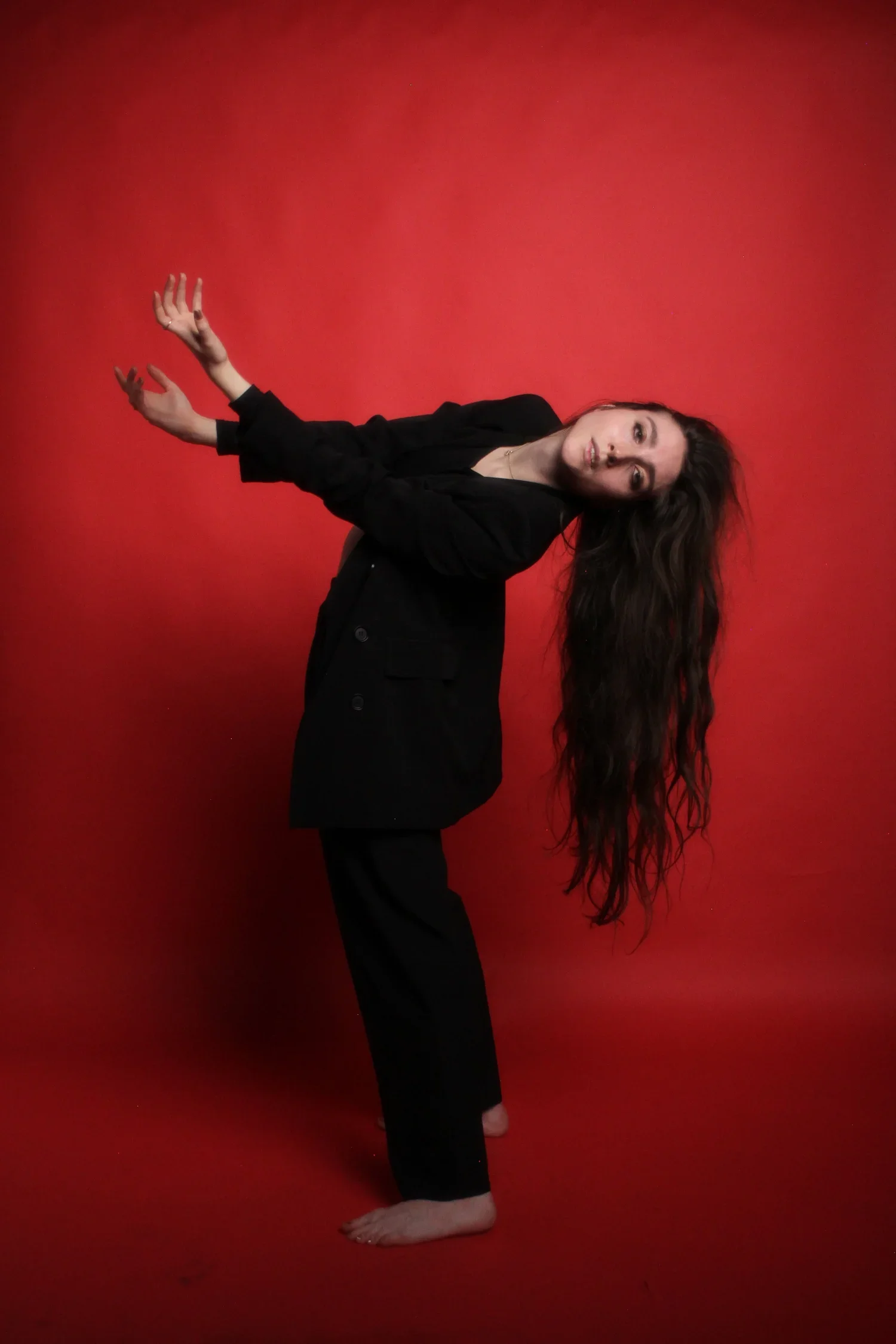
A Sonic Portrait
By Annie Nikunen
I recommend reading the descriptions beneath each track before listening to them.
About this portfolio:
This portfolio is conceived as a portrait of breakthroughs—works that mark decisive “aha” moments in my compositional and broader artistic journey. Because composing is a constant state of becoming, I chose not to present an uncoordinated list of pieces, but rather a curated sequence that reflects turning points: moments when my artistic language clarified, expanded, or fundamentally shifted.
The works span large-scale visions (Bloom, The Sound of Space Between Us), music born from embodied practice and performance in both flute and dance (all mass is interaction, our breaths in partnered sleep), collaborative authorship (Side A of my first co-composed album), and self-directed explorations in electronics (Ascending Pendulum). Together, they form a composite self-portrait, revealing not just what I make, but how and why I make it. This reflects the full scope of my practice—not as a collection of disconnected skills or side pursuits, but as an intentional, rigorously trained, and deeply integrated artistic life.
If you’d like to see more of my flute playing and dancing, there are reels for optional viewing below the tracks, as well as a reel of my film scoring.
About me:
As a composer as well as flutist, dancer and choreographer, I believe that composition is not confined to sound alone, but is a way of organizing time, bodies, space, and attention. I approach composition as an expanded practice—one that treats movement, breath, gesture, and physical presence as compositional materials alongside pitch, rhythm, harmony, timbre.
I work at the intersection of disciplines, and in both traditional and experimental music-making. My practice integrates composition, flute performance, dance, and choreography as interdependent tools within a single methodology. I move intentionally between rigorously notated systems and fluid, exploratory creative environments, drawing on both historical forms and self-built structures. I am equally comfortable writing for orchestras and string quartets, creating ambient electronic works, and engaging in co-composed collaborations.
I don’t fit neatly into a box—and I don’t want to. I’ve performed music by composers ranging from Gérard Grisey and Julius Eastman to Jean Sibelius and Bobby Ge, and have performed and presented work at venues including the Whitney Museum, The Smithsonian, Chatham PS21, Roulette, The Noguchi Museum, and site-specific environments such as The Clark. I’ve trained and worked across classical and contemporary dance, from Balanchine-based practices to traditional and interdisciplinary companies.
A familiar set of questions tends to arise around my work: How do you do it all? Are you really this, or really that? Wouldn’t it be better to focus on one thing? I understand the skepticism—interdisciplinary work nowadays can often be associated with dabbling, or “breadth without depth.” My practice is a direct rebuttal to that assumption. Each discipline I work within is grounded in long-term, formal training and sustained professional engagement. What defines my work is not the range of skills alone, but the depth of the intersections between them. I compose in the way I do because I’m a mover. I choreograph in the way I do because of my deep musical knowledge and training.
I started ballet before kindergarten, flute in elementary school, composing in middle and high school, and choreographing in college. I’ve accumulated the kind of long-form, embodied practice often summarized as “10,000 hours” in music and dance, but the idea of being only a flutist, only a dancer, etc. never sat right. I trained seriously as a ballet dancer and was offered a year-round trainee program at the Joffrey Ballet, yet ultimately chose not to pursue the conventional company trajectory. There was the physical toll–I didn’t want to submit my body to a system that would eventually break it, or shape it into a single, narrow physical ideal. I also felt a strong pull toward finding my voice in music. After leaving ballet to pursue music more fully, I returned to dance with a new perspective: one less rigid, more generous toward the body’s individuality, aging, and expressive capacity. Similarly, while I remain an active flutist, I did not want a life defined solely by anxiety-ridden auditions, spending all my time in a practice room, or a single performance identity. I wanted to incorporate these disciplines into my life and work on my own terms, and composition emerged as the anchor.
I increasingly see myself as a director-composer—someone who thinks in collages, environments, and frames, particularly in film and hybrid performance contexts where roles can productively overlap. In film and media contexts, I like being asked to think in hybrids (“Blade Runner meets Blinding Lights”, as I was told scoring Mission: Gladiator [see film reel]), and in building musical worlds from those collisions. Dance films, in particular, have become a nexus for my work, allowing me to compose, choreograph, perform, and direct within a unified vision. Whether I’m working within established musical lineages or reimagining how music functions in dialogue with other media, the space between these disciplines is where my work lives.
-
Suggested excerpt: 4:44 to 8:04 (mm.120 to 207)
My time as a Composition Fellow at Tanglewood changed my life, marking a profound turning point: I realized I needed to write what I wanted to hear, rather than contorting my work to meet external expectations. I submitted a portfolio that reflected the full range of my practice, and for the first time felt deeply celebrated for being myself. Bloom, commissioned by Tanglewood, emerged directly from this epiphany and remains the piece that feels most fully “me.” I see it as a blossoming of myself as much as the flowers I wrote about.
Written in just a few weeks, Bloom grew not from a grand conceptual premise, but from something deceptively simple and personal: my daily walks through the Brooklyn Botanic Garden. I kept trying to wait for this huge magnum-opus-worthy idea, but I discovered that my most resonant work could arise from ordinary sources of joy. The work’s long ascension—particularly the passage beginning around 6:45 and culminating in a vast release of air—especially embodies this sense of blossoming, both musical and personal.
-
Suggested excerpts: 1:30 to 8:08 (mm.33 to 178); 9:17 to 9:50 (mm.204 to end)
In all mass is interaction, I sought to express physical movement solely through sound. The piece emerged from choreographing and dancing in the studio, then translating those embodied gestures into rhythmic cells, phrasing, and long arcs of motion. Written for my time at Tanglewood, it marked a departure from the slower music that had previously dominated my work, opening onto a more active, sparkly musical language.
I found a particular joy in riding the solo flute line atop a shimmering string texture—a balance of propulsion and suspension. Morton Feldman’s Piano and String Quartet, a work I have choreographed to for several years, was a significant influence on my thinking about texture and time. I also realized I had written a technically demanding flute part that felt both virtuosic and deeply natural to perform.
-
Suggested excerpt: 6:16 to 10:30
This is Side A of my first co-composed album with composer, guitarist, and recording engineer Matt Sargent, a collaboration we have been developing over nearly five years. It is primarily based on improvisatory material around chords we notated. The project emerged from a shared pursuit of an abstract emotional state—one we could sense clearly in its impact, but not yet in its sonic form. Much of the process involved circling that feeling, trusting it, and waiting for the precise sounds to reveal themselves.
I carry a mental catalogue of moments when music has struck me with that initial rush of “I need to hear that again”: through headphones, in a concert hall, on the radio station as a DJ, or in the dance studio. Occasionally, through patience and collaboration, we are able to capture that sensation ourselves. This album represents one of those rare instances—an attempt to make audible the elusive experiences that first drew us to music.
-
Suggested excerpt: 1:51 to 4:10 (mm.16 to 42)
our breaths in partnered sleep was born from a late-night idea while mourning the loss of someone who once slept beside me. The following day, I rented a studio, called up a violinist friend, and began filming—working intuitively from grief, memory, and physical sensation.
The piece explores intimacy through embodiment: the composer and performer function simultaneously as sound sources and movers, while the solo violin assumes an orchestral role through multi-tracking. Filmed aerially with two pillows placed on the floor, the work centers on the absence and ephemerality of the relationship between two spaces in a bed; a most private and vulnerable place. Through choreographic prompts, the violinist and I move with, around, and against the empty space beside us.
Drawing on my background in ballet and movement-based performance, I sought to reimagine “partnering” not through physical contact, but through memory. The music expands and contracts with breathing patterns, treating synchronized respiration during sleep as a quiet, intimate form of duet—partnering through presence, memory, and shared rhythm.
-
Suggested excerpt: 0:39 to 4:05
Ascending Pendulum reflects my growing interest in short-form, cinematic, and song-adjacent composition. The piece began from a directorial impulse: I imagined a solitary figure in a dark apartment, moving through psychological turmoil—memory flickering between joy and devastation. As with much of my work, I often compose in reverse, first envisioning scenes or movements and then writing music to inhabit them.
Created from scratch, this piece also represents my evolving relationship with electronics as a kind of partner dance—an exploration of movement and sound mediated through Ableton, discovering new modes of responsiveness and intimacy between body, technology, and emotional narrative.
-
Suggested excerpts: 8:47 to 13:24 (letter H to m.280); 4:25 to 6:55 (mm.100 to 147)
The Sound of Space Between Us for orchestra is the final installment of a trilogy exploring connection across distance, time, and even death—abstracted emotional and spatial relationships that can be applied to anyone. Each version—for multi-tracked solo violin, string quartet, and orchestra—shares a common sonic DNA while expanding in scale, structure, and narrative complexity. The entire project originated from a four-measure theme, which becomes a constant presence amid shifting musical environments.
Across the trilogy, a solo violin functions as a persistent voice—suggestive of an inner self navigating a changing body, circumstances, and emotional landscapes. In the orchestral version, this idea expands into embedded duos at multiple scales (violin and orchestra, flute and orchestra, piano and harp), abstracting relationships between two individuals into layered musical systems. Distance, absence, and memory shape how sound and movement interact, where gestures and sonic events are choreographed to embody psychological and physical phenomena.